
AI vs Automation: Key Differences, Examples & Use Cases Step by Step
The debate around AI vs Automation is growing as businesses rush to adopt smarter technologies. While both aim to improve efficiency, Artificial Intelligence (AI) and Automation are fundamentally different in how they work, what they solve, and where they fit.
This guide explains the key differences between AI and automation, real-world examples, use cases, and which one is better for business.
Definition of AI
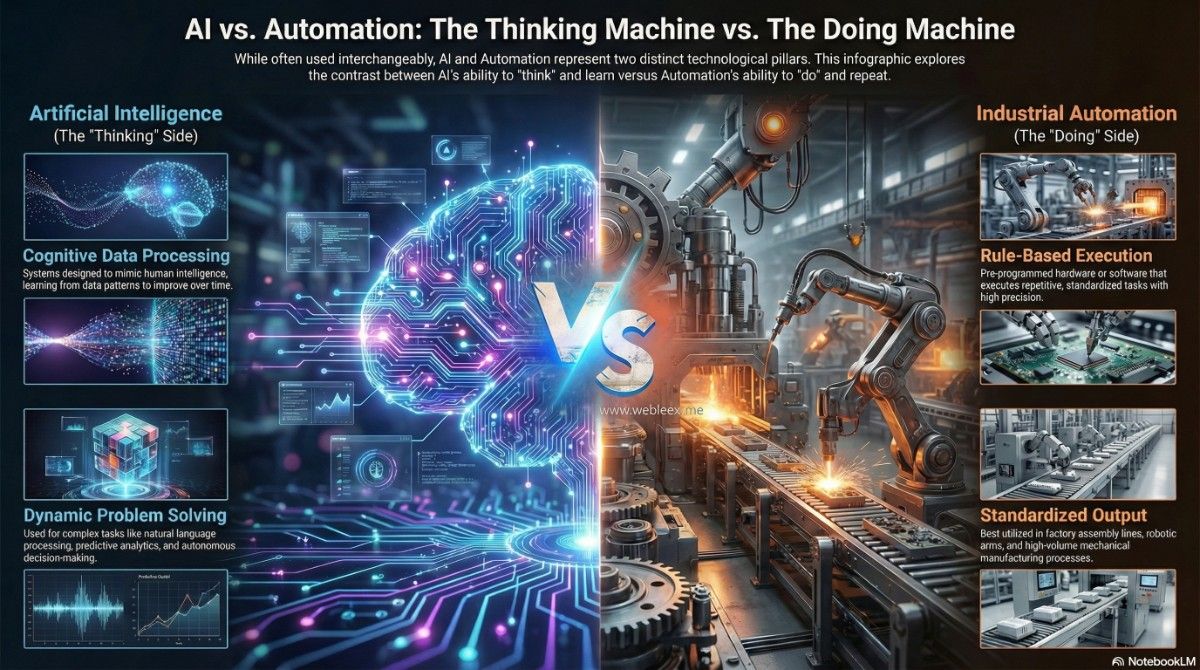
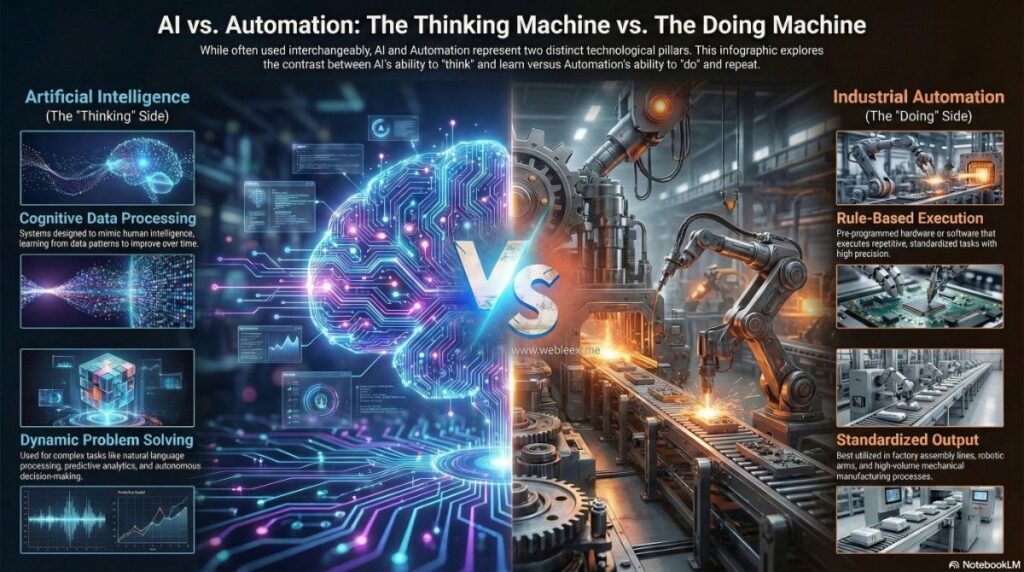
Artificial Intelligence (AI) refers to systems that simulate human intelligence to think, learn, analyze data, and make decisions.
AI systems improve over time using data and can handle unstructured, complex, and dynamic situations.
Core Capabilities of AI:
- Learning from data (Machine Learning)
- Understanding language (NLP)
- Image & facial recognition
- Predictive analytics
- Decision-making
👉 AI focuses on intelligence, not repetition.
Definition of Automation
Automation is the use of technology to perform tasks automatically using predefined rules, without human intervention.
Automation does not learn or adapt. It simply executes instructions exactly as programmed.
Common Automation Examples:
- Email autoresponders
- Payroll processing
- Manufacturing assembly lines
- Scheduled backups
- Robotic Process Automation (RPA)
👉 Automation focuses on speed and consistency.
Key Differences Between AI & Automation
Understanding the intelligent automation difference starts with one simple idea:
- AI thinks
- Automation executes
Core Difference Explained:
- AI handles uncertainty and decisions
- Automation handles repetition and rules
When combined, they create intelligent automation, but alone they serve very different purposes.
AI vs Automation Comparison Table
| Feature | Artificial Intelligence | Automation |
|---|---|---|
| Learning Ability | Yes | No |
| Decision Making | Yes | No |
| Rule-Based | Partial | Fully |
| Adaptability | High | None |
| Data Dependency | High | Low |
| Human-like Reasoning | Yes | No |
| Example | ChatGPT | RPA Bot |
Use Cases of AI
AI is best used where judgment, prediction, and learning are required.
Popular AI Use Cases:
- AI chatbots for customer support
- Fraud detection in banking
- Recommendation engines (Netflix, Amazon)
- Medical diagnosis & imaging
- Predictive maintenance
- Voice assistants
👉 These are classic automation vs AI examples where automation alone would fail.
Use Cases of AutomationAutomation is ideal for high-volume, repetitive tasks with clear rules.
Popular Automation Use Cases:
- Invoice generation
- Data entry
- Payroll systems
- Email marketing workflows
- Order processing
- File backups
👉 Automation increases speed but cannot adapt on its own.
Which Is Better for Business?
The real answer is: it depends on the task.
Choose Automation When:
- Tasks are repetitive
- Rules are fixed
- No decision-making is required
- Speed and consistency matter
Choose AI When:
- Data is unstructured
- Decisions are required
- Patterns must be identified
- Systems need to improve over time
Best Strategy:
Most modern businesses use AI + automation together — also known as intelligent automation.
According to IBM, intelligent automation helps businesses reduce costs, improve accuracy, and scale operations efficiently.
Future of AI & Automation (What to Expect Next)
As technology evolves, the line between AI vs automation will continue to blur. Businesses are moving beyond basic automation toward intelligent, self-improving systems that can handle end-to-end workflows with minimal human input.
In the coming years, AI systems will become more context-aware, while automation tools will integrate deeper decision-making capabilities. This shift will enable:
- Hyper-personalized customer experiences
- Real-time business process optimization
- Smarter supply chains and operations
- Faster innovation with reduced operational costs
Organizations that invest early in AI-driven automation strategies will gain long-term advantages in scalability, efficiency, and competitiveness.
👉 The future belongs to businesses that combine intelligence with execution, not those that rely on one alone.
FAQs
What is the main difference between AI and automation?
The main difference is that AI can learn and make decisions, while automation only follows predefined rules.
Can automation work without AI?
Yes. Traditional automation works perfectly without AI but cannot adapt or improve on its own.
Is AI a type of automation?
No. AI is not automation. However, when AI is combined with automation, it becomes intelligent automation.
Final Verdict
The AI vs automation debate isn’t about choosing one over the other.
Automation handles repetition, AI handles intelligence — and together they power the future of digital transformation.
If your process needs thinking → AI
If your process needs speed → Automation
If you want scale → AI + Automation