
n8n, Zapier, and Make all automate repetitive work, but they are built for different kinds of teams. If you want the fastest no-code setup and the broadest app coverage, Zapier is usually the easiest starting point. If you prefer a highly visual scenario builder, Make is a strong middle ground. If you need deeper logic, self-hosting, AI workflows, or more control over how automation runs, n8n is often the better fit.
This comparison focuses on the decisions that matter in 2026: workflow complexity, pricing model, integrations, AI capability, self-hosting, maintenance, and who will actually manage the automation after it goes live.
n8n vs Zapier vs Make: Quick Comparison
| Area | n8n | Zapier | Make |
|---|---|---|---|
| Best for | Technical teams, AI workflows, custom logic, self-hosting | Beginners, business teams, fast SaaS integrations | Visual multi-step automation and operations teams |
| Pricing logic | Cloud pricing based mainly on workflow executions; self-hosted option available | Task-based usage | Operation-based usage |
| Learning curve | Medium to high | Low | Medium |
| Self-hosting | Yes | No standard self-hosted edition | No standard self-hosted edition |
| Custom code | Strong | Available, but generally less central to the product | Available for advanced scenarios, with a visual-first workflow model |
| AI workflow flexibility | Strong for agentic and custom AI workflows | Strong AI orchestration with task-based usage | Useful AI modules inside visual scenarios |
| Best starting point | When control and flexibility matter most | When speed and ease matter most | When visual flow design matters most |
There is no universal winner. The best choice depends on your workflow volume, team skill level, integration requirements, data-control needs, and how much maintenance you are willing to own.
What Is n8n Best At?
n8n is a workflow automation platform aimed at users who want more control over automation logic. It supports hosted plans and self-hosting, and its workflows can combine triggers, API calls, databases, code, AI nodes, webhooks, conditions, loops, and human approval steps.
If you are new to the platform, start with our What Is n8n? guide before comparing advanced platform differences.
Where n8n stands out
- Self-hosting: useful when you need more control over infrastructure, network access, or data handling.
- Complex workflow logic: useful for branching, data transformation, multi-step processing, APIs, and developer-heavy workflows.
- AI automation: n8n can be used to build workflows that call models, tools, databases, and approval steps. See our n8n AI Agent tutorial for a practical example.
- Custom integrations: HTTP requests and code make it possible to connect services even when a polished native integration is not available.
- Execution-based cloud pricing: n8n states that its paid cloud plans charge by workflow execution rather than charging for each individual step.
As of October 2026, n8n lists a Starter plan at €20 per month when billed annually for 2,500 workflow executions, while its Pro plan is listed at €50 per month annually for 10,000 executions. Pricing can change, so always verify the official n8n pricing page before making a purchase decision.
Where n8n may be the wrong choice
n8n is not automatically the cheapest choice once you include engineering time. Self-hosting means you may need to manage updates, backups, uptime, secrets, monitoring, database health, worker scaling, and security. A business that only needs a few simple “when this happens, do that” automations may get better total value from a managed no-code platform.
What Is Zapier Best At?
Zapier is usually the easiest of the three for non-technical teams. Its strength is breadth and speed: Zapier currently advertises connections to more than 9,000 apps, making it attractive when a business depends on many SaaS products and wants ready-made actions without building APIs manually.
Where Zapier stands out
- Fast onboarding: business users can build useful automations without learning servers, containers, or deployment.
- Large integration catalog: useful for mainstream sales, marketing, CRM, support, productivity, and operations software.
- Low maintenance: Zapier manages the platform infrastructure.
- Built-in tools: filters, paths, delays, tables, forms, and other workflow features reduce the need for external utilities.
- AI orchestration: Zapier now includes AI steps and agent-oriented tooling alongside traditional workflows.
Zapier’s usage model is task-based. Its documentation explains that successful action steps generally consume tasks, while some built-in tools do not. In 2026, Zapier also changed AI-step task consumption so different model tiers can consume different numbers of tasks. That makes cost estimation important for workflows that use multiple AI calls or tools.
For the latest details, use Zapier’s official pricing page and task usage documentation.
Where Zapier may be the wrong choice
Zapier can become less attractive when a workflow performs many billable actions at high frequency. It can also be less suitable when you need self-hosting, deep infrastructure control, private network access, or highly custom execution logic. The easiest builder is not always the most economical system at scale.
What Is Make Best At?
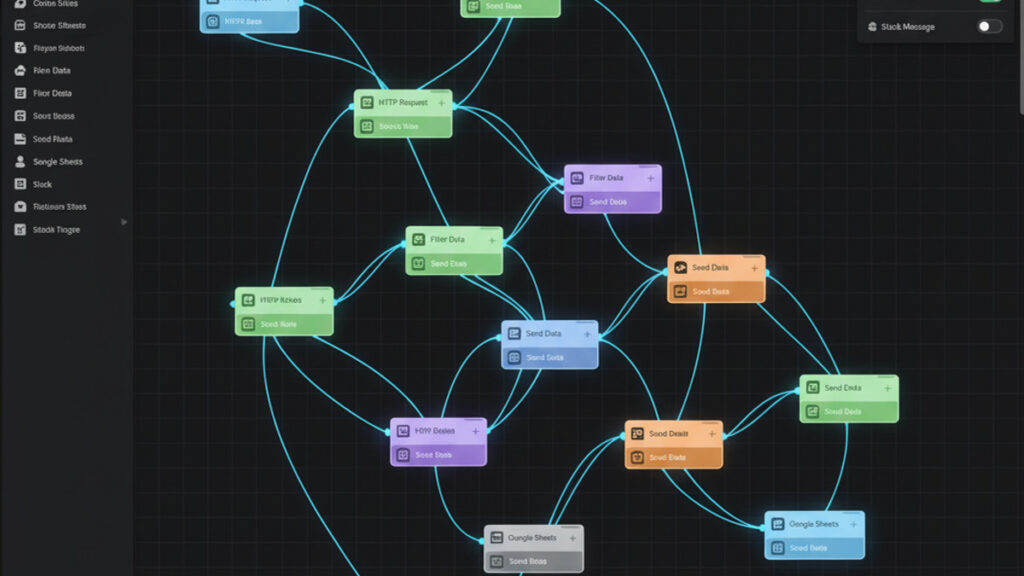
Make is a visual automation platform built around scenarios made of connected modules. It is especially appealing to users who want to see data move through branches, routers, filters, iterators, and transformations on a visual canvas.
Where Make stands out
- Visual workflow design: complex routing can be easier to understand when the entire scenario is visible.
- Data transformation: Make is strong for workflows that repeatedly transform, filter, aggregate, and route structured data.
- Balanced learning curve: it is generally more technical than simple Zapier workflows but does not require you to operate your own server.
- Operations-focused model: useful when you want granular visibility into how modules run.
Make describes an operation as a module run that processes or checks data. A single scenario execution can therefore use multiple operations depending on how many modules run and how many data bundles are processed. This matters when estimating usage for high-volume scenarios. Review Make’s official operations documentation and current pricing before comparing costs.
Where Make may be the wrong choice
Make is a cloud-first platform, so it does not provide the same self-hosting flexibility as n8n. Very large visual scenarios can also become difficult to maintain if they grow without naming standards, modular design, error handling, and documentation.
n8n vs Zapier vs Make for AI Automation
AI changes the comparison because a workflow may now do more than move data. It may classify text, call a language model, search a knowledge base, use tools, wait for approval, and then take an action.
n8n is a strong choice when the AI workflow needs custom logic, APIs, data stores, model flexibility, or infrastructure control. Zapier is attractive when AI needs to act across a very large catalog of business apps with minimal setup. Make works well when the AI step is one part of a visually designed operations workflow.
The important question is not “Which platform has AI?” All three can participate in AI-powered automation. The better question is:
How much control do you need over the AI workflow, and who will maintain it when something fails?
For reliability, every production AI automation should include logging, error handling, limits, and a safe fallback. Our n8n error workflow guide explains how to catch failures and alert the right person.
n8n vs Zapier vs Make for Data Control and Security
If data control is a major requirement, n8n’s self-hosting option is a meaningful differentiator. A team can run n8n in its own environment and control network access, storage, backups, credentials, and deployment practices.
However, self-hosting does not automatically make a workflow secure. You are responsible for hardening the server, protecting secrets, updating the software, limiting webhook exposure, monitoring logs, and preventing accidental data leakage. For public integrations, review our n8n webhook security guide.
Zapier and Make reduce infrastructure maintenance because the vendor operates the platform, but organizations still need to review data-processing terms, connected-app permissions, user access, retention, and compliance requirements.
Which Platform Is Easier for Beginners?
Zapier is usually the easiest starting point. A beginner can often connect two common apps and build a working automation quickly.
Make comes next: the canvas is intuitive for visual thinkers, but bundles, mapping, routers, iterators, and operation usage take time to understand.
n8n has the steepest learning curve of the three, especially if you self-host it. The trade-off is that the extra complexity gives technical users more control once workflows become advanced.
Which Platform Is Better for Developers?
For developers, n8n is usually the most flexible choice because APIs, code, webhooks, credentials, databases, and self-hosted services fit naturally into the workflow model. It can also sit closer to internal systems than a cloud-only automation service.
That does not mean developers should always choose n8n. If the goal is simply to connect common SaaS tools and hand ownership to a non-technical operations team, Zapier may be easier to maintain. Make can be a strong compromise when developers design the scenario but operations staff need a visual system they can understand.
How to Choose Between n8n, Zapier, and Make
Choose n8n if:
- You need self-hosting or tighter infrastructure control.
- Your workflows use APIs, custom code, databases, AI agents, or complex logic.
- You expect workflows to become technically sophisticated.
- You have someone who can maintain the system.
- You want cloud pricing based on workflow executions rather than paying for every individual workflow step.
Choose Zapier if:
- You want the fastest setup.
- Your team is primarily non-technical.
- You depend on many mainstream SaaS tools.
- Your workflows are relatively straightforward.
- You prefer managed infrastructure over deep technical control.
Choose Make if:
- You prefer a visual workflow canvas.
- You build multi-step data-routing scenarios.
- You want strong transformation and branching without self-hosting.
- Your team can learn a moderately technical automation platform.
A Practical Decision Framework
Before choosing a platform, estimate one real workflow from start to finish. Do not compare only marketing feature lists.
- List every trigger and action. Include API calls, AI steps, filters, loops, notifications, and database writes.
- Estimate monthly volume. How many records, leads, tickets, orders, or events will pass through the workflow?
- Map the billing unit. n8n Cloud focuses on executions, Zapier uses tasks, and Make uses operations. These are not directly equivalent.
- Price the human work. Include setup, debugging, updates, monitoring, and maintenance—not only subscription cost.
- Check integration gaps. Confirm every critical app and API before committing.
- Define security requirements. Decide whether cloud processing is acceptable and whether self-hosting creates additional operational risk.
- Build a proof of concept. Run the same representative workflow before migrating an entire automation stack.
This method usually gives a better answer than asking which tool is “best” in isolation.
Common Mistakes When Comparing Automation Tools
Comparing only the monthly plan price
A low subscription cost can be misleading if the workflow needs many billable tasks or operations, while self-hosting can look cheap until maintenance time is included.
Ignoring failure handling
A workflow that works in a demo can still fail in production because of API rate limits, expired credentials, malformed data, timeouts, or vendor outages. Monitoring and recovery should be part of the design from day one.
Choosing based on integration count alone
Thousands of integrations are valuable only if they include the specific actions your workflow needs. An HTTP/API connector may sometimes be more important than a large catalog.
Self-hosting without an operations plan
Running n8n yourself gives you control, but it also gives you responsibility. Backups, upgrades, secrets, database maintenance, HTTPS, access control, and monitoring should be planned before production use.
Frequently Asked Questions
Is n8n better than Zapier?
n8n is better when you need self-hosting, custom logic, APIs, technical flexibility, or complex AI workflows. Zapier is usually better when ease of use, fast setup, and broad SaaS integration coverage matter more.
Is n8n cheaper than Zapier?
It can be, especially for workflows with many steps or when self-hosting is appropriate. But the real cost must include infrastructure and maintenance. Because n8n executions and Zapier tasks are different billing units, compare a real workflow rather than a headline price.
Is Make easier than n8n?
For many users, yes. Make’s visual canvas can be easier to learn than a self-hosted n8n setup. n8n becomes attractive when workflows require more technical control.
Can n8n replace Zapier?
For many workflows, yes, but not always. You should first confirm that n8n supports the required apps, authentication methods, API actions, data volume, and maintenance model.
Which is best for AI agents?
n8n is particularly strong for custom agent workflows that combine tools, APIs, data stores, code, and human approval. Zapier can be easier when an agent mainly needs to take actions across common SaaS apps. The best choice depends on control, cost, and maintenance requirements.
Which tool should a small business choose?
A non-technical small business with simple workflows may prefer Zapier. A business that wants visual multi-step scenarios may prefer Make. A technically capable business that needs flexibility, AI automation, or self-hosting may prefer n8n.
Final Verdict
Choose Zapier for simplicity, Make for visual workflow design, and n8n for control and technical flexibility.
For many growing teams, the right answer may even be a mixed stack: use the easiest managed tool for simple automations and reserve n8n for workflows where custom logic, data control, AI, or scale justify the additional complexity.
Whichever platform you choose, start with one high-value workflow, measure the time it saves, build proper error handling, and only then expand automation across the business.