
What Is Artificial Intelligence & Automation? (Complete Beginner Guide)
Artificial Intelligence (AI) and Automation are transforming how businesses, industries, and even daily life function. From smart assistants to automated factories, AI-powered automation is everywhere — yet many beginners still confuse these terms or use them interchangeably.
This guide explains what Artificial Intelligence & Automation really are, how they differ, how they work together, and why AI automation is becoming the backbone of modern technology. Like N8N.
What Is Artificial Intelligence?
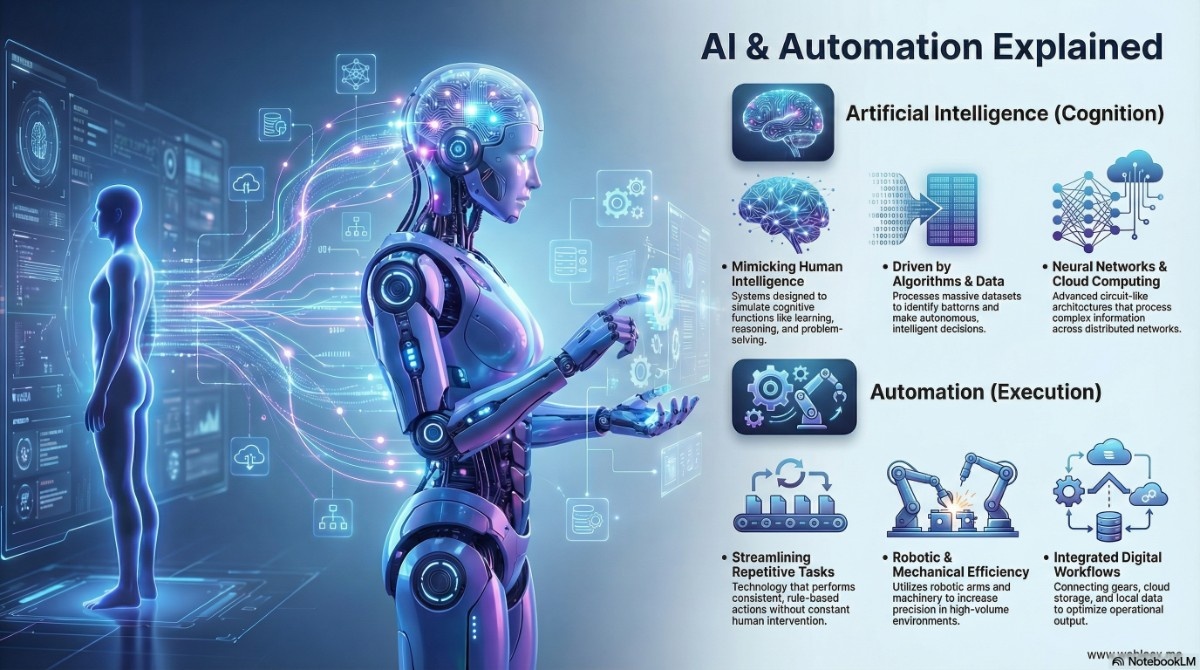
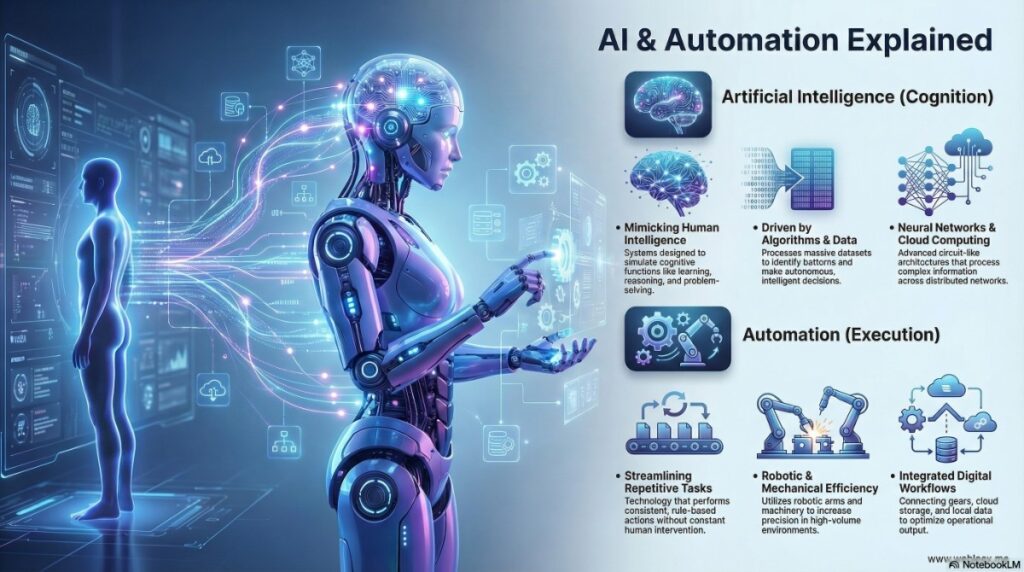
Artificial Intelligence (AI) is the ability of machines to simulate human intelligence.
AI systems can learn, reason, analyze data, recognize patterns, and make decisions without being explicitly programmed for every scenario.
Key Characteristics of AI Systems:
- Learning from data (Machine Learning)
- Understanding language (Natural Language Processing)
- Visual recognition (Computer Vision)
- Decision-making & prediction
- Continuous improvement over time
Simple Example:
- Google Maps predicting traffic
- Chatbots understanding customer queries
- Netflix recommending shows
👉 In short: AI thinks, learns, and adapts.
What Is Automation?
Automation is the use of technology to perform tasks without human intervention by following predefined rules or instructions.
Automation does not think or learn — it simply executes what it’s told.
Common Automation Technology Examples:
- Email autoresponders
- Payroll processing systems
- Assembly line robots
- Scheduled backups
- Excel macros
Simple Example:
- Sending invoices automatically every month
- Turning lights on/off at fixed times
👉 In short: Automation follows rules.
How AI & Automation Work Together
When Artificial Intelligence is combined with Automation, we get systems that not only perform tasks automatically but also make intelligent decisions.
This combination allows businesses to automate complex, unpredictable, and data-driven processes.
Example:
- Automation: Sends customer support replies
- AI + Automation: Understands the customer issue and sends the right reply
👉 AI adds brain, automation adds speed.
AI vs Automation (Comparison Table)
| Feature | Artificial Intelligence | Automation |
|---|---|---|
| Decision Making | Yes | No |
| Learning Ability | Yes | No |
| Adaptability | High | None |
| Rule-Based | Partially | Fully |
| Data Dependency | High | Low |
| Human-like Thinking | Yes | No |
| Example | ChatGPT | Email Scheduler |
What Is Intelligent Automation?
Intelligent Automation is the advanced form of automation that uses AI systems such as machine learning, NLP, and computer vision to handle complex workflows.
It allows automation to:
- Understand unstructured data
- Learn from past actions
- Improve performance automatically
Components of Intelligent Automation:
- Artificial Intelligence
- Machine Learning
- Robotic Process Automation (RPA)
- Data Analytics
👉 Intelligent automation is the future of automation technology.
Real-Life Examples of AI Automation
Here’s where AI automation is already making a huge impact:
Business & Industry
- Automated invoice processing
- Fraud detection in banking
- Predictive maintenance in factories
Healthcare
- AI-powered diagnosis
- Automated patient scheduling
- Medical image analysis
Marketing & Sales
- AI chatbots
- Personalized email campaigns
- Lead scoring systems
Daily Life
- Voice assistants (Alexa, Siri)
- Face unlock in smartphones
- Smart home automation
Benefits of AI Automation
🚀 Major Advantages:
- Increased efficiency & speed
- Reduced human errors
- Cost savings in long term
- Better decision-making
- 24/7 availability
- Scalable operations
Business Impact:
Companies using AI automation gain competitive advantage, faster turnaround time, and improved customer experience.
Risks & Limitations
Despite its benefits, AI automation has limitations:
⚠️ Key Risks:
- High initial implementation cost
- Data privacy concerns
- Dependency on quality data
- Job displacement fears
- Ethical & bias issues in AI systems
👉 AI automation must be implemented responsibly and strategically.
FAQs
What is AI automation in simple words?
AI automation means machines that automatically do tasks and also think, learn, and decide like humans.
Is automation possible without AI?
Yes. Traditional automation works without AI but follows fixed rules and cannot adapt or learn.
Where is AI automation used?
AI automation is used in banking, healthcare, manufacturing, marketing, customer support, logistics, and smart homes.
Is AI automation expensive?
Initial costs can be high, but long-term savings, efficiency, and scalability make it cost-effective.
Final Thoughts
Understanding the difference between AI and automation is essential in today’s digital world. While automation handles repetition, Artificial Intelligence adds intelligence, making systems smarter and more efficient.
👉 AI automation is not the future — it’s already happening.
If you’re a beginner, start learning now — because businesses that ignore AI automation today will struggle tomorrow