
AI Writing Tools: A Complete Guide
What Are AI Writing Tools?
AI writing tools are software applications powered by artificial intelligence that assist users in generating, editing, or improving written content. These tools leverage advanced natural language processing (NLP) models to understand context, grammar, tone, and style, enabling them to produce coherent and relevant text based on user inputs or prompts. Unlike traditional word processors that rely solely on user input, AI writing tools actively suggest content, correct errors, and optimize text to meet specific goals.
For example, an AI writing tool can help a blogger create a first draft of an article by expanding on a brief outline or generate multiple headline options tailored to different audiences. These tools range from simple grammar checkers to sophisticated platforms capable of mimicking human writing styles, adapting tone, and even generating creative narratives.
How Do AI Writing Tools Work?
Most AI writing tools use machine learning models trained on vast datasets of text from books, articles, websites, and other sources. These models, often based on architectures like transformers, learn patterns in language, syntax, and semantics. When you provide a prompt or partial text, the AI predicts and generates the next words or sentences that best fit the context. This prediction is probabilistic and refined through layers of neural networks to produce coherent and contextually appropriate output.
Some tools incorporate additional modules for grammar correction, style suggestions, and content optimization. For example, grammar modules identify syntactical errors and suggest corrections, while style modules adjust tone—such as making text more formal or casual. SEO optimization features analyze keyword density and recommend structural changes to improve search engine rankings.
Example Workflow
Consider a marketer drafting an email campaign. They input a brief prompt like “introduce our new product with a friendly tone.” The AI generates a draft email, which the marketer reviews and edits for brand voice and accuracy. The tool may also suggest subject lines optimized for open rates. This collaboration accelerates content creation while maintaining quality.
Key Features of AI Writing Tools
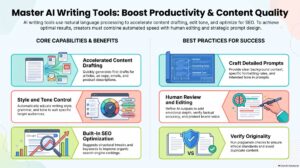
- Content Generation: Automatically create articles, blog posts, marketing copy, emails, and more. For instance, tools can generate product descriptions in bulk, saving hours of manual writing.
- Grammar and Spell Checking: Detect and correct errors to ensure polished writing. Advanced tools go beyond basic spelling mistakes to fix complex grammatical issues and suggest stylistic improvements.
- Style and Tone Adjustment: Tailor text to be formal, casual, persuasive, or friendly. This is particularly useful when targeting different audiences or platforms.
- SEO Optimization: Suggest keywords and structure content to improve search engine rankings. Some tools integrate keyword research and provide real-time SEO scoring.
- Plagiarism Detection: Verify originality and avoid duplicate content. This is crucial for academic, professional, and marketing contexts to maintain credibility.
- Multilingual Support: Generate or translate content in multiple languages, expanding reach to global audiences without needing separate translators.
Popular Use Cases for AI Writing Tools
Content Marketing
Marketers use AI writing tools to quickly draft blog posts, social media updates, and ad copy that resonate with target audiences while saving time on brainstorming and editing. For example, an AI tool can generate multiple versions of a Facebook ad caption, allowing marketers to A/B test which performs better. Additionally, AI can suggest trending topics or keywords to align content with current market interests.
Academic Writing
Students and researchers benefit from AI assistance in generating summaries, citations, and improving clarity in essays or reports. AI tools can help paraphrase complex sentences, check for grammatical errors, and format bibliographies according to different citation styles. However, users should be cautious to avoid overreliance, ensuring that the final work reflects their own understanding and voice.
Business Communication
Professionals use AI to draft emails, proposals, and presentations with consistent tone and error-free language. For instance, AI can help tailor emails for different recipients by adjusting formality and emphasizing key points. This streamlines communication, reduces misunderstandings, and enhances professionalism.
Creative Writing
Authors and content creators leverage AI to overcome writer’s block by generating story ideas, dialogues, or descriptive passages. AI can propose plot twists, character descriptions, or setting details that spark inspiration. While AI-generated creative content may require refinement to add emotional depth, it serves as a valuable brainstorming partner.
Benefits of Using AI Writing Tools
- Increased Productivity: Generate drafts faster and reduce time spent on editing. For example, a content team can produce more articles per week, meeting tight deadlines without sacrificing quality.
- Enhanced Creativity: Get fresh ideas and alternative phrasings to enrich your writing. AI can suggest synonyms, idioms, or sentence structures that diversify your style.
- Consistency and Accuracy: Maintain a uniform tone and correct grammar throughout your content, which is especially important for brand voice and professionalism.
- Cost-Effective: Reduce reliance on professional writers for routine content creation, freeing budget for strategic projects.
- SEO-Friendly Content: Improve search engine visibility with keyword suggestions and optimized structure, increasing organic traffic.
Common Limitations and How to Overcome Them
While AI writing tools are powerful, they have some limitations that users should be aware of to use them effectively and responsibly:
- Context Understanding: AI may misinterpret nuanced or complex topics without clear instructions. For example, subtle irony or cultural references might be lost or misrepresented. To mitigate this, provide detailed prompts and review outputs carefully.
- Creativity Boundaries: AI-generated text can sometimes feel generic or lack emotional depth. It excels at pattern recognition but struggles with genuine human experiences or unique insights. Users should treat AI output as a starting point, adding personal touches and creativity.
- Quality Variation: Output quality depends on the tool’s underlying model and prompt quality. Poorly phrased prompts often yield irrelevant or awkward text. Experimenting with prompt phrasing and using advanced tools with better models can improve results.
- Ethical Concerns: Overreliance on AI can lead to plagiarism or reduced originality if not carefully managed. Always verify content originality with plagiarism checkers and avoid submitting AI-generated work as entirely your own in contexts where originality is required.
To maximize effectiveness, always review and edit AI-generated content, provide detailed prompts, and use plagiarism checkers when necessary. Combining human judgment with AI assistance ensures high-quality, ethical, and authentic writing.
How to Choose the Right AI Writing Tool
Choosing the right AI writing tool depends on your specific needs and preferences. Consider these factors carefully to select a tool that aligns with your goals:
- Purpose: Identify your primary use case—content creation, editing, SEO optimization, etc. For example, if you need SEO-focused content, prioritize tools with robust keyword integration.
- Features: Look for grammar checking, tone adjustment, language support, and integration options. Some tools offer API access for embedding AI capabilities into your own software.
- User Interface: Choose a tool with an intuitive and easy-to-navigate interface. A cluttered or complex UI can slow down your workflow.
- Pricing: Compare subscription plans and free trial availability to fit your budget. Some tools offer pay-as-you-go models, which might be cost-effective for occasional users.
- Data Privacy: Ensure the tool complies with data protection regulations and secures your content. This is especially important for sensitive business or academic materials.
Additionally, check user reviews and trial the tool yourself to assess how well it meets your expectations before committing.
Getting Started with AI Writing Tools
- Sign Up and Explore: Register for a reputable AI writing platform with a free trial if available. Use this period to familiarize yourself with features and limitations.
- Define Your Goals: Determine what content you want to generate or improve. Clear goals help you use the tool more effectively.
- Craft Clear Prompts: Provide detailed instructions or keywords to guide the AI output. For example, instead of “write about marketing,” specify “write a 500-word blog post on social media marketing strategies for small businesses, with a friendly tone.”
- Review and Edit: Always proofread AI-generated content to ensure accuracy and originality. Edit for style, tone, and factual correctness to maintain quality.
- Optimize for SEO: Use keyword research and structure your content for better search engine performance. For more on SEO, see our AI for SEO: A Complete Guide.
By following these steps, you can integrate AI writing tools into your workflow safely and productively.
Conclusion
AI writing tools represent a significant advancement in content creation technology, offering users the ability to produce high-quality text faster and more efficiently. By understanding how these tools work, their benefits, and limitations, you can harness their power to enhance your writing process while maintaining originality and clarity. Remember that AI is a tool to augment human creativity, not replace it. Start experimenting with AI writing tools today to boost your productivity and creativity in writing projects, ensuring you combine the best of both human insight and artificial intelligence.
Frequently Asked Questions
What are the best AI writing tools available?
Popular AI writing tools include Jasper, Grammarly, Copy.ai, and Writesonic. The best choice depends on your specific needs such as content type, budget, and desired features. For example, Grammarly excels at grammar and style correction, while Jasper is known for content generation and marketing copy.
Can AI writing tools replace human writers?
AI tools assist with drafting and editing but cannot fully replace human creativity, critical thinking, and nuanced understanding required for quality writing. They are best used as collaborators or assistants rather than substitutes.
Are AI writing tools suitable for SEO content?
Yes, many AI writing tools offer SEO optimization features to help improve keyword usage and content structure, enhancing search engine rankings. However, combining AI suggestions with human expertise in SEO strategy yields the best results.
Is the content generated by AI tools original?
AI generates unique text based on patterns learned but it’s important to use plagiarism checkers to ensure originality and avoid unintentional duplication. This is especially critical in academic and professional contexts.
How can I improve the quality of AI-generated content?
Provide clear, detailed prompts and always review, edit, and tailor the output to your audience and purpose for best results. Experiment with different prompt styles and incorporate your own knowledge to enrich the content.